

Kwekerij Dirk Mermans, located in Wommelgem, Belgium, is a leading European greenhouse nursery specializing in high-quality indoor plants. As a fifth-generation family business, it has evolved to a modern facility spanning over 45,000 m². The nursery is renowned for its expertise in both hydroculture and soil cultivation, boasting a 90% market share in hydroculture plants and pioneering the indoor cultivation of Strelitzia nicolaii in Northern Europe. Additionally, it is the largest producer of Monstera variegata in the region.
The objective of the flexibility project is to lower the total cost of heat (opex), as well as the CO2 footprint, as required for the greenhouse, all without having an impact on the plant growing.
What is the scope of your flexibility project in terms of assets or processes?
Our situation is as follows:
- Assets: 1.5 MWe CHP, 1.4 MWe electrical boiler, 850 m³ stratified hot water tank
- Operations : 4.5 ha of greenhouses with a very seasonal and weather dependent heating requirement.
- Flexibility opportunity: Possibility to decouple heat production from heat demand by using stratified hot water tank. Having multiple assets (energy vectors) to produce heat also provides an opportunity to optimise.
Concretely, Kwekerij Mermans has a day-ahead contract where daily nomination is required and imbalance risk is passed through, i.e., there is the opportunity of buying/selling energy on the day-ahead market and the deviation from the nomination is invoiced based on the imbalance price.
The CHP is scheduled on day-ahead and can deviate from the schedule to take opportunities on the imbalance market. The e-boiler is operated opportunistically on the imbalance market, helping the grid while making low cost and low CO2 heat.

Cogeneration

E-boiler
How did you go about implementing the project and delivering the expected flexibility?
Dirk Mermans, the owner of the company, personally led the entire project from start to finish. It was essentially a one-man show—he had a strong vision, believed in the idea, and simply went for it. His hands-on approach ensured that everything was tailored to the specific needs of the business.
Dirk knew what he was looking for. First, the solution needed to be independent from the party providing the market access (e.g., independent from any energy supplier or Balancing Responsible Party (BRP) or Balancing Service Provider (BSP)), because he wants to maintain its full freedom when it comes to selecting energy providers or renegotiating terms.
Secondly, the solution should consider that there are technical and operational boundaries which need to be respected, as after all optimising the energy economics only makes sense when it does not create other problems or costs. One example is taking
into account the wear and tear on the assets - by monitoring and limiting the number of starts and stops of the CHP unit, it helps reduce maintenance needs and extend the equipment’s lifespan.
And thirdly, it needed to be easy to integrate with the existing systems and equipment on site, without the need of too much additional hardware or adaptations.
Ultimately, he chose for Entras as flexibility service provider, which with their Endustries software are able to perform advanced control of both the combined heat and power (CHP) unit and the electric boiler. The system uses smart algorithms to steer these assets in the most economical way. Importantly, it also takes operational wear and tear into account—by monitoring and limiting the number of starts and stops of the CHP unit, it helps reduce maintenance needs and extend the equipment’s lifespan.
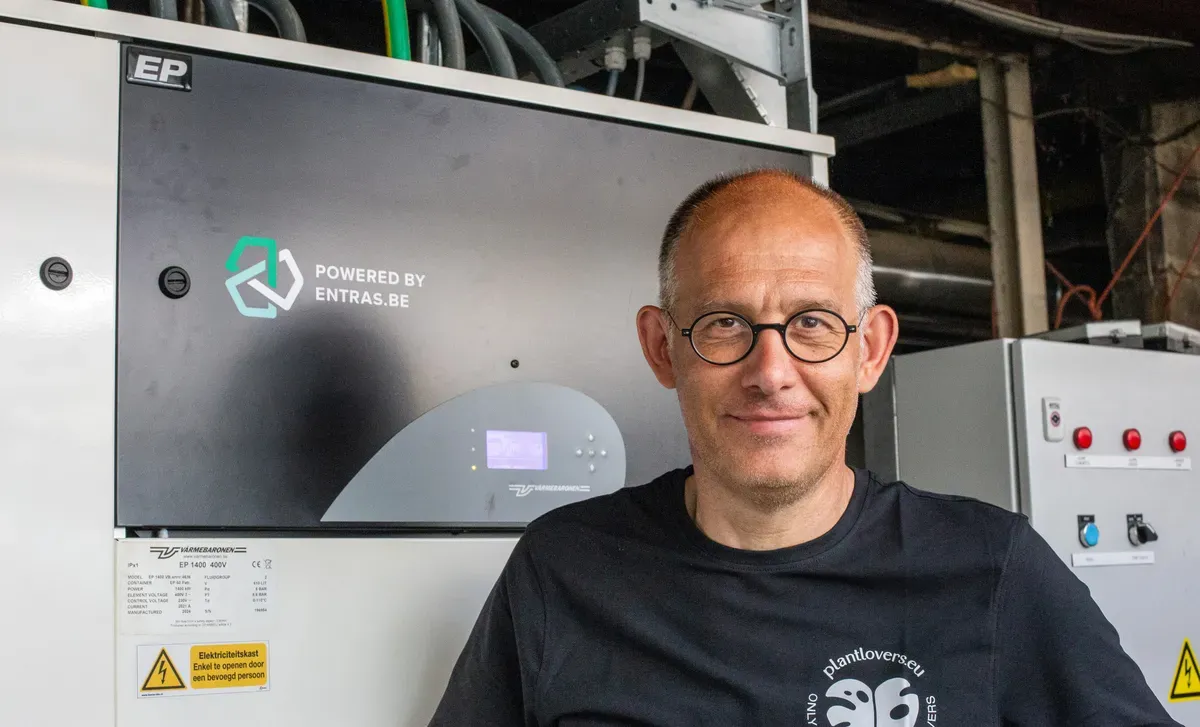
To make the boiler a viable part of the energy system, it became essential to implement intelligent control. Simply turning it on whenever heat was needed would have been too costly. Instead, the system now uses smart control strategies to operate the electric boiler only during economically favourable moments
Looking back, how did the implementation go? Did you reach the expected results?
One of the key challenges faced in the project was the shift in the company’s energy profile. Previously, the site operated as a net producer of electricity, which meant that grid usage was minimal and associated costs—such as capacity tariffs—remained very low. This changed significantly with the introduction of the electric boiler.
While the electric boiler brought flexibility and the potential for more sustainable heat generation, it also introduced a new issue: extremely high and concentrated peaks in electricity consumption. These short but intense spikes in offtake triggered much higher capacity tariffs, which are calculated based on peak demand rather than total energy use. In some cases, the additional grid costs threatened to outweigh the financial benefits of using the electric boiler for heating.
To make the boiler a viable part of the energy system, it became essential to implement intelligent control. Simply turning it on whenever heat was needed would have been too costly. Instead, the system now uses smart control strategies to operate the electric boiler only during economically favourable moments—taking into account real-time energy prices, demand profiles, and crucially, the potential impact on grid capacity charges. The aim is to ensure that the savings on heating costs are never undermined by unexpectedly high grid fees.
From a financial perspective, the smart control of the electric boiler alone (CHP not included) has led to a significant reduction in heating costs—averaging between €1.00 and €1.50 per square meter per year. This improvement reflects the system’s ability to optimize energy use without triggering excessive grid charges, making a noticeable impact on the overall operational efficiency.
between €1.00 and €1.50 per square meter
yearly savings
From a financial perspective, the smart control of the electric boiler alone (CHP not included) has led to a significant reduction in heating costs—averaging between €1.00 and €1.50 per square meter per year.
This improvement reflects the system’s ability to optimize energy use without triggering excessive grid charges, making a noticeable impact on the overall operational efficiency.

Latest case studies
Let's hear what some professionals have to say about their use of flexibility services

